Date:
Author:
Ashish Choudhury
Welcome to the Experience Economy.
The term itself is hardly new. A brief search will quickly surface a Harvard Business Review article from the late 1990s bearing the same name. Still, its relevance today is difficult to dispute. We now operate in an economy where value is increasingly defined not by products alone, but by the experiences that surround them.
Rather than labour the point, let us accept this premise and move forward. History shows that stable, successful systems—economic or otherwise—tend to evolve toward being people-centric. It was therefore almost inevitable that companies like Apple, Amazon, and Google would follow this trajectory. This shift matters because the way people buy, consume, and commit has fundamentally changed.
The economy has moved away from a simple product-to-customer transaction toward a model in which the customer sits at the centre. Experiences now play a decisive role in purchase decisions, revealing three clear behavioural patterns.
Consumers are outcome-oriented.
Ownership is no longer the prize it once was. Flexible financing, widespread access, and diminishing patience have made results matter more than possession.Personalisation is expected.
The one-size-fits-all approach has lost its appeal. Relevance now defines value.Obsolescence is unacceptable.
Continuous innovation is no longer aspirational—it is assumed. The familiar refrain of “Apple isn’t innovating anymore” is itself evidence of this expectation.
This shift is global and industry-agnostic. Publications like The Economist, Forbes, and Forrester have repeatedly noted its effects. The consequences of ignoring it have been severe. More than half of the Fortune 500 companies from fifteen years ago—including Toys “R” Us, Blockbuster, and Compaq—no longer exist.


So how have consumer-facing companies responded?
Many have turned to apps as a means of cultivating deeper relationships with their customers—capturing loyalty, maintaining engagement, and nudging behaviour with well-timed incentives. L Brands’ Victoria’s Secret provides a telling example. Its Pink Nation app targeted college students through gamification, influencer partnerships, and curated content, building an engaged community that extended seamlessly into commerce, including branded credit cards. Simple, effective, and quietly strategic.
Apple’s response follows the same logic—just executed at a vastly different scale.
If you view Apple’s devices as platforms rather than products—very expensive platforms, admittedly—the model becomes clearer. Each device is an entry point into an ecosystem designed to remain ever-present in the user’s life, reinforcing brand recall while encouraging incremental engagement and consumption through both Apple-owned and third-party services.

Reliability
We believe in pushing the boundaries of design, storytelling, and innovation to create brands that not only look stunning but also leave a positive impact on the world. That’s why we’re excited to unveil our newest exploration—an immersive project built to redefine how brands express authenticity from the ground up.
We approach every project with a commitment to clarity, precision, and purposeful design. Our goal is to craft brands that don’t just communicate—they resonate on a deeper, more meaningful level with the people who interact with them.
Where Apple truly distinguishes itself, however, is in its positioning.
For decades, Apple has anchored its identity in simplicity, elegance, and intuitive innovation. These qualities place it in a uniquely strong position within the experience economy.
Outcome orientation
Through financing options and strategic partnerships, Apple has lowered the barriers to entry. Once inside the ecosystem, users are introduced to a growing suite of subscription services—Apple TV+, Arcade, News+, and others—designed to deepen reliance and increase switching costs. Residual consumer value is captured through Apple Pay and, more recently, Apple Card.
Personalisation through restraint
Apple is not endlessly customisable—and that is precisely the point. For its audience, removing unnecessary choices and delivering a refined, dependable experience is the desired form of personalisation.
Innovation as ecosystem design
Steve Jobs famously remarked that people don’t know what they want until you show it to them. Apple’s most successful products—the iPhone, iPad, and Apple Watch—did exactly that. Over time, hardware and software have been woven into a cohesive ecosystem that prioritises continuity over novelty. Accessories reinforce this loop, and if current signals are accurate, this integration will only deepen.
Apple Card represents a particularly telling move. Apple Pay opened a door into financial services; Apple Card widened it. What began as an ecosystem-bound payment tool now signals broader influence. If adoption continues at pace, Apple will have raised switching costs yet again—while positioning itself to challenge aspects of retail banking itself.
Five years from now, will consumers queue at a bank branch to open an account, or complete the process in moments through a device already embedded in their daily lives?
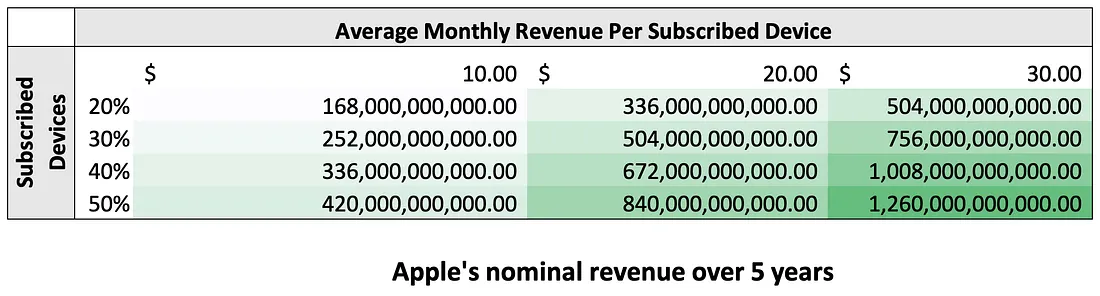
From subscriptions alone, conservative estimates suggest significant revenue potential over the coming years. Combined with Apple’s device ecosystem and its expanding presence in financial services and healthcare, the company’s growth trajectory appears anything but fragile.
So we return to the original question:
Is Apple truly faltering due to a lack of innovation—or has innovation simply taken a quieter, more structural form?